The Challenge: Keeping Up with a Fast-Moving Job Market
In today’s fast-paced employment landscape, job seekers expect timely, comprehensive, and accurate job listings delivered seamlessly through digital platforms. Our client, a prominent job aggregation site, faced rising operational challenges. Their job was to consolidate postings from multiple leading sources, including Indeed, ZipRecruiter, and FlexJobs, into a single website efficiently and reliably;
Initially, the platform relied heavily on manual processes: team members visited hundreds of job boards daily, copying relevant listings and manually reformatting them to fit the client’s website standards. This painstaking approach was not only labor-intensive but also prone to data quality issues such as duplicates and outdated job postings lingering on the platform. Consequently, user experience suffered due to inconsistent and incomplete listings.
As user expectations evolved and the volume of online job postings exploded, the manual workflow became unsustainable. The client’s coverage was limited; only a fraction of job boards could be monitored efficiently, and crucial listings were often missed or updated too slowly to benefit job seekers. The team spent considerable time on repetitive data collection tasks, reducing their capacity for strategic development or enhancing user engagement. Likewise, the lack of automated monitoring increased risks of downtime or delayed updates caused by unnoticed technical errors. These challenges made it clear the client needed a smarter, scalable solution capable of keeping pace with the growing complexity of the online job market and expanding business needs.
This need for rapid, reliable job market intelligence was critical to maintain competitive advantage and deliver actionable insights for users.
Our Solution: Intelligent Automation Blending Code and No-Code Tools
To meet the client’s challenges, we developed a flexible, largely automated job aggregation system combining custom-coded solutions with no-code automation platforms such as n8n.
The system’s key components include:
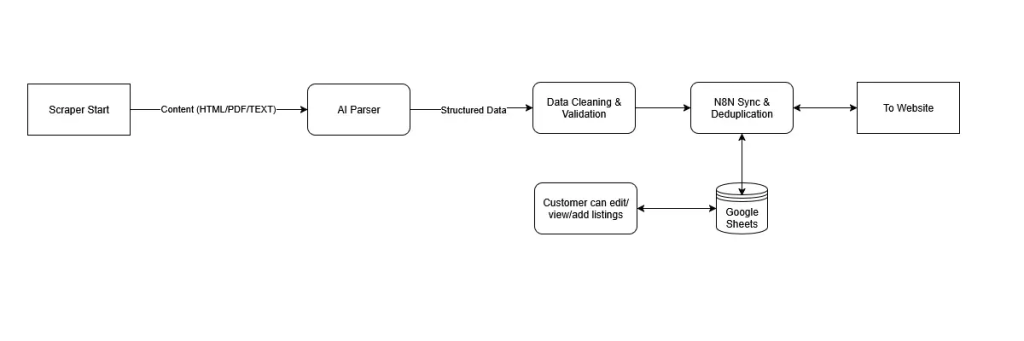
- Automated Web Scraping: The system extracts job postings programmatically from multiple data sources such as traditional job boards and corporate career sites. It accommodates diverse formats including PDF, HTML, and plain text.
- AI-Powered Parsing: Leveraging the OpenAI GPT-5 API, the solution intelligently parses and interprets raw data from these varied formats. This stage converts unstructured information into structured listings containing standardized fields like job title, company, location, and posting date.
- Structured Data Output: Following parsing, data is formatted into a clean, well-organized representation that supports easy search and display on the client’s platform. This step ensures all listings follow a consistent format of structured job data to enhance usability.
- Data Cleaning and Profiling: This automated process removes duplicates, corrects errors, and validates listings to ensure high data quality. Profiling identifies anomalies or missing information to flag for revision.
- No-Code Data Sync and Client Access:
Instead of syncing job data directly to a website, the cleaned, structured listings are automatically synced to Google Sheets using the no-code automation tool n8n.
This approach gives the client direct access to review, add, or modify job postings easily before final use, providing a flexible and transparent layer of data control.
The entire scraping, processing, and categorization workflow is:
- Fully automated and runs daily without manual intervention,
- Scheduled during off-peak hours to minimize any impact on user experience,
- Designed to ensure consistent and fresh job listings and real time data delivery.
Robust error logging and alerting mechanisms monitor each automated run and notify the operations team immediately if any extraction failures or data issues arise, ensuring minimal downtime and maximum data freshness.
This implementation leverages leading workflow automation solutions and highlights the power of AI driven automation to improve data handling and operational efficiency.
To illustrate this process, the following flowchart outlines the main steps involved in the job aggregation pipeline:
The Results: Dramatic Improvements in Scale, Accuracy, and Efficiency
The intelligent automation overhaul dramatically improved the client’s platform operations within just a few weeks:
- Volume Growth: The system increased daily processed and published job listings from approximately 1,000 to over 10,000, marking a 10-fold surge in aggregated data without a corresponding increase in manual workload.
- Data Quality: Automated normalization and AI categorization raised data consistency from an estimated 70% to more than 98%. The system drastically reduced duplicate and erroneous listings, enhancing the search experience for users.
- Engagement Metrics: Improved data quality and freshness correlated with significant upticks in user activity. Average session duration increased by 20%, indicating users were spending more time effectively exploring job opportunities. Application click-through rates also rose by 15%, pointing to higher user conversion and interest.
- Labor Efficiency: Manual data processing dropped by over 90%, saving the team more than 5.5 hours daily (from roughly 6 hours down to under 30 minutes). Freed from repetitive tasks, staff could shift focus to enhancing the platform and growing the business.
- Source Scalability: The client’s coverage of job boards and corporate sites tripled, rising from under 50 to over 150 data sources worldwide. This was achieved without increasing manual effort thanks to the system’s modular, scalable design.
- Reliability Improvements: System uptime achieved 99.8%, a substantial improvement that minimized downtime and disruption. Automated alerting shortened incident response from multiple days down to mere hours, reducing risk and frustration.
Thanks to this streamlined and scalable job aggregation system, the client now offers richer, fresher job content for users while operating more efficiently at scale.
The Tangible Impact of Automation
In summary, the automation dramatically enhanced the client’s operations. The metrics speak volumes:
- 10x daily job listings processed and published (from 1,000 to 10,000+)
- Data consistency improved from ~70% to 98%
- Manual labor cut by over 90% (6 hours to <30 minutes per day)
- Source scalability tripled (from under 50 to 150+ job boards)
- System uptime at 99.8% with rapid incident response
- User engagement increased (time on site +20%, click-through +15%)
These results clearly show how the automation delivered richer content faster, with less effort and greater reliability, positioning the client for sustained growth in a competitive market.
Moving Forward
This successful blend of custom automation with no-code orchestration tools and advanced AI powered by OpenAI GPT-5 has positioned the client’s platform for sustained innovation and competitiveness.
The platform now provides:
- Operational efficiencies that free resources for strategic development.
- An enriched, accurate, and timely job listings experience that delights users.
- Scalable infrastructure allowing agile addition of new data sources and features.
Ready to Transform Your Job Platform?
If your business is aiming to boost efficiency, accuracy, and user engagement with intelligent automation and AI, reach out today to explore tailored solutions designed for your growth.